
Aug
Reviews
Behringer WING Compact Review: Is This One of the Best Digital Mixers for Live Sound in 2026?
If you are looking for a powerful professional digital mixer that can handle live sound, churches, concerts, touring, recording, streaming and complex audio production, the Behringer WING Compact deserves serious consideration.
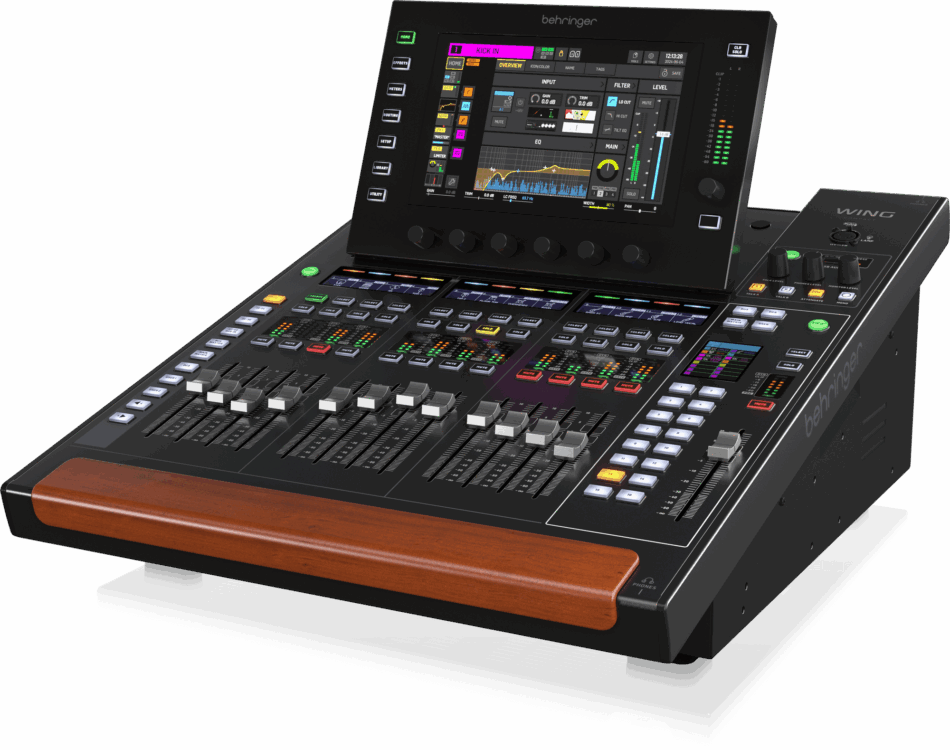
The WING Compact takes the processing power and flexible workflow of the original Behringer WING and puts it into a significantly more compact control surface. Despite its smaller footprint, it retains an impressive 48-channel, 28-bus full-stereo architecture, 24 Midas PRO microphone preamps, 13 motorized faders, a 10.1-inch multi-touch display and extensive digital networking capabilities.
For professional sound engineers, churches, bands, event companies, rental companies, studios and production teams, the result is a digital mixing console with an unusually high level of routing, processing and expansion capability for its physical size.
Behringer WING Compact at a Glance
| Feature | Behringer WING Compact |
|---|---|
| Mixing architecture | 48-channel / 28-bus full stereo |
| FlexChannels | Up to 48 |
| Microphone preamps | 24 Midas PRO |
| Main outputs | 8 Midas PRO outputs |
| Motorized faders | 13 × 100 mm |
| Main display | 10.1-inch capacitive touchscreen |
| Effects | 16 true-stereo engines |
| Effects algorithms | 80+ |
| USB audio | 48 × 48 channels |
| Live recording | Up to 64 tracks |
| AES50 | 3 ports |
| StageConnect | Up to 32 channels each direction |
| Networking | Ethernet with optional Dante/Waves SoundGrid |
| Rack mounting | Yes |
| Weight | Approximately 15.92 kg |
Specifications are based on Behringer’s current product information.
What Is the Behringer WING Compact?
The WING Compact is a professional digital mixing console designed to provide much of the functionality of the larger WING in a smaller and more portable format.
Rather than simply reducing the number of channels, Behringer has retained the WING’s underlying architecture. The console provides 48 FlexChannels, allowing channels to be configured as mono, stereo or M/S sources without sacrificing channel count.
This is particularly useful for modern productions where stereo sources are becoming increasingly important.
For example, a sound engineer could configure channels for:
- Vocal microphones
- Drum microphones
- Stereo keyboards
- Playback systems
- Stereo acoustic instruments
- Ambient microphones
- Wireless microphone systems
- Streaming feeds
- Broadcast sources
The flexibility means the console can adapt to the production rather than forcing the production to fit a traditional fixed-channel layout.
Sound Quality: Midas PRO Preamps
One of the biggest selling points of the WING Compact is its 24 Midas PRO microphone preamps.
Midas has a long-standing reputation in professional live sound, and the WING Compact incorporates Midas PRO preamp technology to provide high-quality microphone inputs.
Behringer specifies a typical 111 dB analog-in-to-analog-out dynamic range, while the preamplifier/converter section is rated at approximately 112 dB A/D dynamic range.
In practical terms, this makes the WING Compact suitable for applications where clean microphone amplification and detailed signal processing matter, including:
- Live concerts
- Worship services
- Corporate events
- Theatre
- Broadcast
- Studio recording
- Live streaming
- Touring productions
The console also provides 40-bit internal processing, giving the WING platform considerable processing headroom.
The 10.1-Inch Touchscreen
The WING Compact’s 10.1-inch capacitive touchscreen is central to its workflow.
The display has a 1280 × 800 resolution and can be adjusted through a 15°–60° viewing angle.
Instead of relying exclusively on physical knobs and buttons, the touchscreen provides direct access to routing, EQ, dynamics, effects, channel configuration and other console functions.
For engineers accustomed to software-based digital mixing, this approach can feel very intuitive.
The main advantage is that the console does not require a huge number of dedicated physical controls to provide access to a large number of functions.
13 Motorized Faders: Small Surface, Big Console
The WING Compact has 13 motorized 100 mm faders.
At first glance, this might seem like a disadvantage compared with larger consoles. However, the WING Compact is designed around layers, customizable banks and touchscreen navigation.
The console’s fader section can accommodate input channels, auxiliary channels, buses, mains, matrices, DCAs and customized banks.
This allows engineers to organize the surface around the way they actually mix.
For example, a church engineer could create a layer containing:
- Lead vocal
- Backing vocals
- Acoustic guitar
- Electric guitar
- Bass
- Kick
- Snare
- Drum overheads
- Keys
- Playback
- MC microphone
- Effects
Another layer could then contain monitor mixes, buses or DCAs.
One of the WING Compact’s Best Features: Sends on Fader
For live sound engineers, the Sends on Fader workflow is one of the most useful features of the WING Compact.
Dedicated controls and hot keys provide quick access to buses, mains, matrices and DCAs.
This is particularly valuable when mixing monitors.
Instead of navigating through complicated menus to determine how much of each channel is being sent to a particular monitor mix, the engineer can quickly switch to the relevant bus and adjust channel sends.
For bands, churches and live production companies, this can make monitor mixing significantly faster.
48 Channels and 28 Stereo Buses
The WING Compact is far more powerful than its physical dimensions suggest.
The console provides:
- 48 FlexChannels
- 16 stereo aux buses
- 8 stereo matrix buses
- 4 stereo mains
- 8 DCAs
- 8 mute groups
This gives the engineer substantial flexibility for complex productions.
The stereo architecture is particularly useful for modern productions involving stereo playback, immersive monitoring, keyboards, electronic instruments and broadcast feeds.
Effects and Processing
Another major strength of the WING Compact is its internal processing.
The console includes 16 true-stereo effects engines and more than 80 effects algorithms.
The effects collection includes processing inspired by a range of well-known studio and live-sound hardware, including compressors, EQs, reverbs, delays, modulation processors and other signal-processing tools.
The WING also provides dedicated plug-in processing slots for channel gate, dynamics and EQ.
This means you can build sophisticated channel strips without needing external processors for many applications.
For a touring production or mobile event company, that can significantly reduce the amount of outboard equipment required.
Recording: A Major Advantage
The WING Compact isn’t only a live mixing console.
It also includes a 48-channel USB audio interface, making it possible to integrate the mixer directly with a computer-based recording environment.
It also includes a dual-SD-card recorder/player capable of handling up to 64 tracks.
That opens up several useful applications:
- Multitrack live recording
- Virtual soundcheck
- Concert recording
- Playback
- Rehearsal recording
- Podcast production
- Live streaming
- Studio tracking
The virtual soundcheck capability is especially valuable.
A band can record a performance, and the engineer can later replay the multitrack material through the console to practice mixing without requiring the musicians to be physically present.
AES50 and StageConnect
The WING Compact is designed to operate as part of a larger digital audio ecosystem.
Three AES50 ports provide extensive digital I/O connectivity over SuperMAC networking. Behringer specifies up to 144 input/output signals through the three AES50 connections.
The console also includes StageConnect, which can transport up to 32 channels of 24-bit audio in either direction using a single XLR connection.
For larger installations, this means the WING Compact can serve as the central control surface while stageboxes and other compatible devices handle audio connections closer to the performers.
Dante and Waves SoundGrid Expansion
For professional installations and larger production environments, networking is another major advantage.
The WING Compact can be expanded with optional networking solutions supporting technologies such as Audinate Dante and Waves SoundGrid.
This can make the console suitable for:
- Large venues
- Corporate AV
- Broadcast
- Touring
- Distributed audio systems
- Recording facilities
- Networked production environments
For companies planning to expand their audio infrastructure over time, the expansion architecture is an important consideration.
Remote Mixing and Software Control
The WING ecosystem includes several software applications, including:
- WING Edit
- WING CoPilot
- WING Q
- LiveSessions
- StageConnect Configurator
WING Edit provides desktop control and offline editing, while WING Q is designed around monitor mixing and CoPilot provides remote mixing capabilities.
This is particularly useful in churches and venues where the engineer may need to make adjustments from different locations.
It also means you can prepare shows and configurations away from the physical console.
Behringer WING Compact vs WING
The obvious question is: Why buy the WING Compact instead of the original WING?
The answer largely comes down to physical workflow.
The original WING provides a larger control surface with 24 motorized faders, while the WING Compact provides 13. Both are based on the WING architecture and provide extensive routing, processing and networking capabilities.
Choose the WING Compact if:
- You need a smaller footprint
- Portability matters
- You work from smaller FOH positions
- You frequently use rack or compact production setups
- You want WING processing without the size of the flagship surface
Choose the full-size WING if:
- You want more physical faders immediately available
- You regularly mix large productions
- You prefer a larger hands-on control surface
- You have sufficient FOH space
The WING Compact is therefore not simply a cheaper version of the WING. It is a different physical workflow built around the same broader ecosystem.
Behringer WING Compact vs X32
For owners of an X32 or M32 system considering an upgrade, the WING Compact is particularly interesting.
The WING platform moves beyond the X32 architecture with a more flexible stereo channel concept, extensive routing, modern touchscreen control and a substantially expanded effects and processing environment.
The WING Compact also retains compatibility with the broader Behringer/Midas digital ecosystem, including compatible stageboxes.
If you already own an X32-based system, the transition may therefore be considerably easier than moving to an entirely different manufacturer’s ecosystem.
Pros of the Behringer WING Compact
1. Exceptional processing power
The amount of processing, routing and effects available from a console of this size is impressive.
2. 24 Midas PRO preamps
The Midas PRO microphone preamps are a major attraction for professional live sound applications.
3. 48 FlexChannels
The ability to configure channels as mono, stereo or M/S provides significant flexibility.
4. Excellent recording capabilities
The 48-channel USB interface and 64-track SD recording capabilities make the WING Compact useful beyond live mixing.
5. Powerful networking
AES50, StageConnect and optional Dante/SoundGrid expansion make the system highly scalable.
6. Remote control
The WING software ecosystem allows engineers to configure, control and manage the system from computers and mobile devices.
7. Compact professional format
You get a great deal of WING functionality without needing the physical footprint of the full-size WING.
Cons of the Behringer WING Compact
No mixer is perfect, and the WING Compact has some limitations worth considering.
1. Fader count
With 13 physical motorized faders, engineers who prefer having dozens of channels immediately available may need time to adapt.
2. Learning curve
The WING is extremely powerful, but that flexibility means there is more to learn than on a basic digital mixer.
3. Touchscreen dependency
Engineers who prefer a highly tactile console with a dedicated physical control for almost every function may initially prefer traditional console layouts.
4. Advanced networking can become complex
AES50, Dante, SoundGrid, StageConnect and extensive routing are powerful features, but complex systems require proper network and signal-flow planning.
Who Should Buy the Behringer WING Compact?
The WING Compact is particularly well suited to:
Churches:
Excellent for worship environments requiring multiple monitor mixes, livestream feeds, multitrack recording and scene recall.
Live bands:
Its stereo processing, effects, routing and compact footprint make it a strong choice for touring and live performance.
Event production companies:
The extensive I/O and networking options make it suitable for corporate events, concerts and conferences.
Rental companies:
A WING Compact can provide a powerful production console while occupying less transport and FOH space.
Recording engineers:
The 48-channel USB interface and multitrack recording functionality make it capable of handling serious live recording work.
Broadcast and streaming:
Its routing and processing capabilities allow multiple feeds and destinations to be managed from one console.
Is the Behringer WING Compact Worth It?
The short answer is yes—provided you need its capabilities.
The WING Compact is not a beginner’s mixer in terms of functionality. It is a professional digital mixing system that happens to have a relatively compact control surface.
Its combination of 24 Midas PRO preamps, 48 FlexChannels, 28 stereo buses, 16 stereo effects engines, 48-channel USB audio, 64-track recording, AES50, StageConnect and optional Dante/SoundGrid connectivity makes it an extremely versatile console.
The biggest question is therefore not whether the WING Compact has enough features. It is whether you will actually use them.
For a professional sound engineer, church, production company, touring band or recording facility, the answer can easily be yes.
Behringer WING Compact for the Kenyan Market
For Kenya’s growing live events, worship, corporate AV, entertainment and recording industries, the WING Compact is particularly attractive because it combines a relatively compact physical format with professional-level digital audio capabilities.
It can be deployed for:
- Nairobi churches and worship centres
- Concert production
- Corporate events
- Hotels and conference venues
- Touring musicians
- Wedding and event production
- Live streaming
- Recording studios
- Rental and production companies
For Kenyan production companies, the ability to integrate stageboxes, remote control, multitrack recording and networked audio can also make the WING Compact a useful long-term investment rather than simply a standalone mixer.
Final Verdict
Rating: 9/10
The Behringer WING Compact is one of the most feature-packed compact professional digital mixers available to engineers who need serious routing, processing, recording and networking capabilities.
Its greatest strength is the combination of WING processing power and a significantly smaller physical control surface.
The 24 Midas PRO preamps, 48 FlexChannels, 28 stereo buses, powerful effects, 48-channel USB interface, 64-track recorder, AES50 networking, StageConnect and optional Dante/SoundGrid support make it suitable for everything from church production and live bands to professional event production, recording and broadcast.
The main compromise is the 13-fader control surface. Engineers who demand a large number of physical faders may prefer the full-size WING. For everyone else, the WING Compact offers an impressive balance between power, portability, flexibility and professional functionality.
Bottom Line
If you want a compact digital mixer that can grow with your production, the Behringer WING Compact is one of the strongest options to consider in 2026.
